






- Veröffentlichung:
14.10.2025 - Lesezeit: 12 Minuten
Successfully mastering AI compliance
Creating security, enabling innovation. Artificial intelligence (AI) opens up enormous opportunities for companies – from more efficient processes to completely new business models. At the same time, there is growing pressure to use these technologies in a legally compliant and responsible manner – with the GDPR, EU AI Act and copyright law playing a particularly important role. For many companies, the challenge is to drive innovation forward while avoiding liability risks, fines or loss of trust. This is precisely where sound AI advice in the area of compliance comes in: It creates clarity, security and the freedom to use AI successfully.

The goal of AI compliance in companies

Direct goals for companies to implement AI compliance
The first step is to identify potential sources of risk when dealing with AI. These include data protection violations, discriminatory results, non-transparent decision-making processes and dependencies on third-party providers. There is also a risk of incorrect results due to hallucinations, where AI models generate synthetic or factually inaccurate information.
An assessment is then made of how serious these risks are and whether legal compliance is ensured. Criteria include probability of occurrence, possible legal consequences, impact on customers, employees or partners and financial consequences.
Specific strategies for action are developed on the basis of the assessment – for example, stricter data controls, adjustments to algorithms, additional documentation or training for employees.
As AI systems are dynamic, they must be continuously monitored. Regular checks and audits ensure that the systems remain in line with legal requirements and internal standards.
AI compliance is not a one-off project, but an ongoing process. Experience from monitoring is incorporated into optimization so that measures can be adapted to new legal requirements, technological developments and corporate goals.

Overarching goals of AI compliance
- Protection of personal data
- Transparency in AI decisions
- Safeguarding rights such as privacy, non-discrimination, freedom of expression
- Avoidance of algorithmic bias
- Ensuring that AI treats all population groups equally
- Promotion of equal opportunities
- Clear rules for providers to create a level playing field
- Protection against monopolistic structures through irresponsible use of AI
- Promoting innovation within a secure framework
- Minimization of risks due to incorrect AI decisions (e.g. in healthcare or transport)
- Clarification of responsibilities in the event of damage
- Development of standards for robust, traceable systems
- Strengthening the trust of users, partners and the public in AI applications
- Promoting social acceptance through transparent processes
- Helping companies to introduce AI responsibly
Corporate culture and change management as the key to success
GDPR & TDDDG - Data protection & personal data
When using AI, all existing data protection laws must be complied with – including in particular the General Data Protection Regulation (GDPR) and the Telecommunications Digital Services Data Protection Act (TDDDG). The prerequisite for this is that the use falls within the scope of these laws – i.e. personal data is processed.
The use of external AI systems is particularly critical: If information is entered into such models, the data usually leaves the company and is processed on the provider’s servers. It is often not clear to users whether the requirements of the GDPR are being complied with – a significant risk for companies and data subjects alike.
- Always relevant when AI processes personal data.
- Data protection principles such as lawfulness, transparency and data minimization apply.
- Legal bases for data processing must be fulfilled
- Duty to inform
- Documentation in the register of processing activities.
- Contracts for order processing
- Obligation to carry out a data protection impact assessment (DPIA) for AI applications
- Data transfer to third countries (e.g. LLMs with servers in the USA).
- Entering third-party personal data in chatbots.
- Transparency obligations often difficult to fulfill.
- Careful examination of the AI used for transparency, traceability, documentation and guarantees that third-party providers ensure compliance with the GDPR
- Employee training (also mandatory under the EU AI Act)
- Enable internal company regulations to prevent the outflow of personal data.
Copyright & intellectual property
- Whether an AI output is protected by copyright or infringes third-party rights is always a case-by-case decision.
- Many principles of copyright law can be applied to AI, but they do not solve the socio-political problem
- Copyright law only protects human creations – purely AI-generated works are not protected.
- If third-party protected works are reproduced, translated or copied in essential elements, the rights of third parties may be infringed.
- Prompt texts can be protected as own works if they fulfill the requirements of a personal intellectual creation.
- AI works can only be protected by copyright if they have been edited and creatively developed by humans.
- AI can imitate well-known figures, styles or scenes (e.g. “Image in the style of artist XY”). There is a risk of infringing third-party rights here.
- Lack of clarity and transparency as to who AI-generated or processed AI works are attributable to.
- Risk of damage to reputation if their work or style is imitated without the artists’ consent.
- Do not use generative AI for content that is recognizably based on third-party works.
- Always check and, if necessary, edit AI outputs before they are published or used commercially.
- Clearly mark when content is (partially) AI-generated to create transparency.
- Document prompts and workflows in order to be able to demonstrate creative input.
- Clarification of rights when using AI-generated content.
EU AI Act - New compliance regulations since 2025
The EU AI Act is the European Union’s first comprehensive regulation specifically for artificial intelligence. It aims to protect consumers, promote innovation and strengthen the European single market at the same time. The regulation provides for a gradual timetable: Initial provisions have already been in force since February 2, 2025, with further regulations gradually coming into force by the end of 2030. In our additional summary of the EU AI Act, you will find all the content in detail.
- Central requirement: AI systems are divided into risk classes (low, limited, high, unacceptable risk).
- Particularly relevant for companies with AI systems that process personal or sensitive data, are used in critical areas or have a direct impact on the rights and freedoms of individuals.
- The obligations depend on the classification into risk classes.
- Prohibited practices: manipulative or deceptive AI techniques, social scoring, real-time biometric monitoring without a legal basis.
- Requirements for high-risk systems:
- Strict documentation and transparency obligations
- Risk management and ongoing monitoring
- Traceability and human supervision
- General transparency and disclosure obligations and voluntary codes of conduct: Users must be able to recognize when they interact with AI and how it has been trained.
- You can find all the details on the associated obligations in our blog article on the risk classes of the EU AI Act.
- Companies must clarify at an early stage which category the AI system falls into or whether it is prohibited altogether.
- High expenditure for documentation, test procedures and ongoing tests.
- Risk of competitive disadvantages if companies do not implement requirements on time.
- Carry out a risk classification of all AI systems used at an early stage.
- Adapt internal compliance processes (e.g. conformity assessment, documentation obligations).
- Introduce transparency measures: clear information for users when AI is used.
- Establish ongoing monitoring, e.g. with suitable tools, to comply with new regulatory updates by 2030 .
Your contact for AI compliance

Risks & dangers of AI in companies
- Subliminal or manipulative techniques that influence the behavior of users.
- Social scoring – the evaluation of people based on their behavior or personal characteristics.
- Real-time biometrics in public spaces (e.g. facial recognition), except in narrow exceptions .
- AI systems in critical areas such as healthcare, transportation, education or criminal justice.
- Applications in migration and border control.
- Chatbots or AI systems that can influence people directly.
- Algorithmic distortions (bias) due to incorrect or biased training data.
- Misuse or improper use of data (GDPR, copyright).
- Faulty validation, training or modeling of AI systems.
- Black box character: lack of explainability and traceability of AI decisions.
- Unreliability in practical use, e.g. due to incorrect results or a poor database.
- Lack of monitoring or quality controls.
- Violation of laws or regulations due to poorly secured systems.
- Cybersecurity: Attacks on AI systems (e.g. data poisoning or manipulation of training data).
- Lock-in effects and dependence on providers if companies become heavily dependent on external AI platforms.
- Discrimination against individual groups through algorithmic distortions.
- Lack of fairness in decisions, for example in HR, lending or justice.
- Loss of trust in companies or institutions due to non-transparent use of AI.
Who is particularly affected by AI compliance?







Our solution approach from Ventum Consulting
AI compliance is not a one-off project, but a continuous process. We take a holistic approach so that companies can take advantage of the opportunities offered by artificial intelligence without incurring legal risks. A key component of this is the right data strategy: with clear data governance, it is possible to control which data flows into AI systems and how it is processed. This enables companies not only to comply with GDPR requirements, but also to gain transparency and control over their AI applications.
Why is external support necessary for this? Regulations are complex, there is often a lack of internal experience and resources are limited. Companies can therefore hardly meet the requirements on their own.
- We carry out risk analyses and compliance checks and develop a strategy that leads efficiently to the achievement of objectives.
- Together, clear processes are established and responsibilities created.
- Employee training ensures that knowledge is retained and acceptance of new systems is secured.
- We prepare you for external examinations and certifications.
- As part of data analytics consulting, we create the necessary infrastructure for a future-proof data strategy on which your own AI systems can be built.
As an experienced AI consultancy, our aim is to create security while enabling innovation – not blocking it.
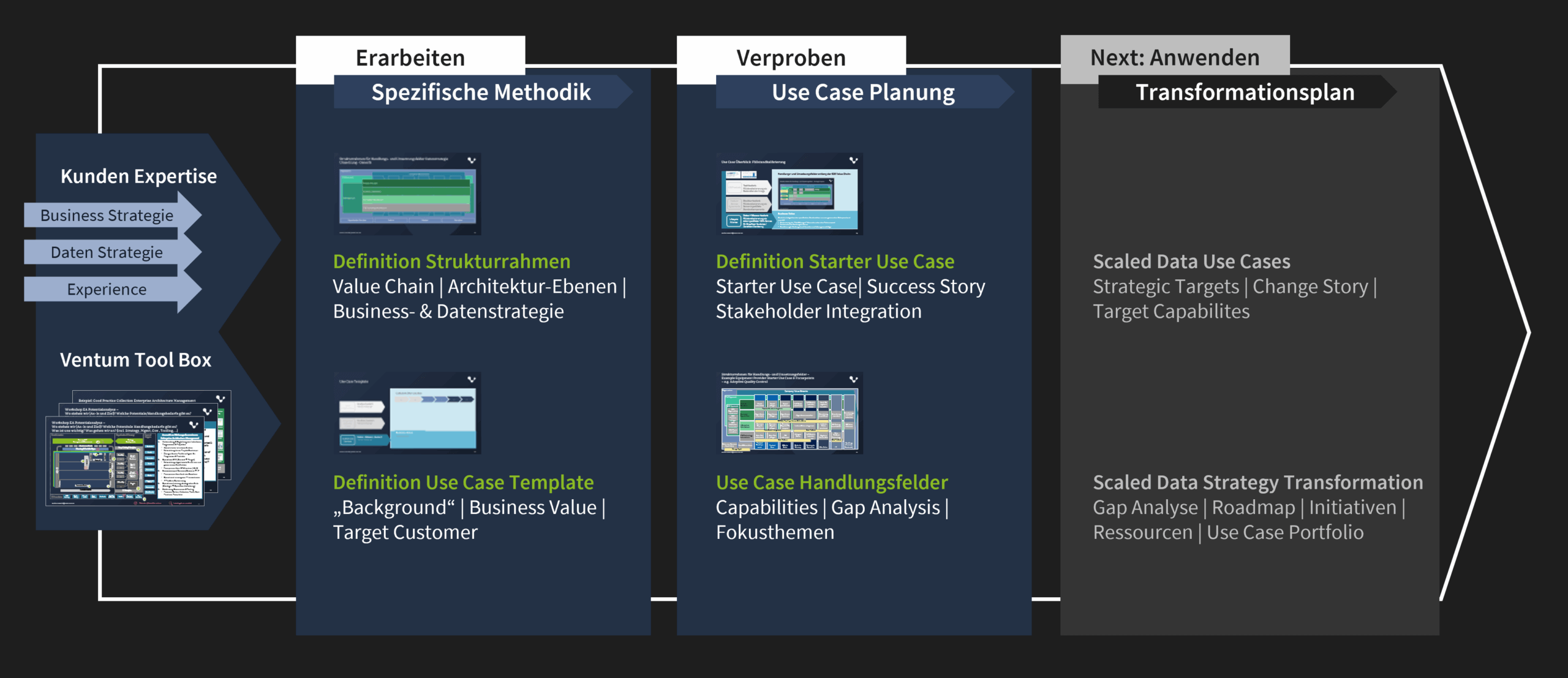
Turn unstructured data into real business value: With our proven kick-off initiative, you can quickly create the basis for modern, data-oriented further development.
- Customized frame including integrated application template
- Immediate project start thanks to preparatory analysis, tried-and-tested templates and efficient methods
- Sophisticated integration concept for seamless interaction and modular, expandable solutions
- Detailed needs analysis for the targeted expansion of skills and resources
Arrange a non-binding initial consultation now
- Legally compliant: Identify risks such as fines and liability traps at an early stage and protect yourself effectively
- Individual: Analysis of your specific AI projects for tailor-made, practical recommendations for action.
- Proven: 20 years of practical experience from successful consulting projects guarantees reliability
- Implementation-oriented: Directly usable measures for more transparency and efficient processes instead of theoretical approaches
- Competitive: Enabling innovation and securing competitive advantages through trustworthy, legally compliant AI applications



TISAX and ISO certification for the Munich office only
Your message