









- Veröffentlichung:
08.07.2026 - Lesezeit: 7 Minuten
Integrated Product Data Management for Production-Related Processes Across a Brand Group – Transparency, Quality, and Stability
Executive Summary – Production Data Management at a Glance
- Strategic Importance: Clean, consistent, and traceable production data is becoming the foundation of digital manufacturing—ensuring quality, stability, and scalability.
- Operational Impact: Consistent attributes, robust routing logic, and clear object relationships prevent errors, reduce the effort required for reconciliation, and speed up approvals.
- Transparency & Governance: A central data model provides clarity on product logic, responsibilities, and data flows—regardless of location or partner network.
- Organizational Capability: Clear roles, understandable rules and regulations, and consistent validation strengthen teams over the long term.
- Success factors: standardization, data harmonization, automated validation, collaborative governance models, and results that can be utilized early on in the system landscape.
Challenges in Production Data Management — Why They Are Critical
In many companies, production data is scattered, inconsistently structured, and often contradictory. Different identifiers, varying attribute sets, differing routing logics, and unclear approval processes complicate day-to-day work in manufacturing, planning, and quality assurance. New product logics must be understood, categorized, and processed, while responsibilities among locations, partner companies, and departments are not clearly defined. This lack of standardization leads to room for interpretation, inconsistent data, and operational uncertainties. The more complex products, variants, and supply chains become, the greater the demand for transparent, stable, and automatable data structures. As a result, companies lose speed, quality, and resilience.
Consequences of These Challenges — As Seen in Production and Management
- Number ranges, object types, and required attributes must first be painstakingly understood and consolidated
- Flexible processes cannot be firmly established or consistently implemented
- Regulatory frameworks must be introduced, abstracted, and, where necessary, harmonized
- Product logic is interpreted in different ways — inconsistencies arise
- Roles and responsibilities are unclear, which delays coordination and approvals

Your Contacts for Production Data Management


Our Solution — Integrated, Reliable Production Data Management
We work with you to develop a data-stable, integrated system that consolidates all relevant product and production data in one place and subjects it to clear rules. Our approach enables the automatic linking of objects, flexible routing and approval logic, validated attribute sets, and transparent object relationships. Errors are detected early, data quality improves continuously, and responsibilities are clearly defined.
The solution integrates technical, logistical, and production-related information into an audit-compliant system that is embedded in your existing IT landscape (ERP, PLM, MES, etc.). We work iteratively and collaboratively to deliver early value—resulting in a stable, scalable production data management system that reduces the workload on teams and unlocks productivity potential.
Benefits at a Glance
- Reduced Risk of Production Downtime
- Higher data quality, less room for interpretation
- Sustainable organizational stability and autonomy
- Better Collaboration Between Locations and Partners
- Early defect detection and consistent quality improvement
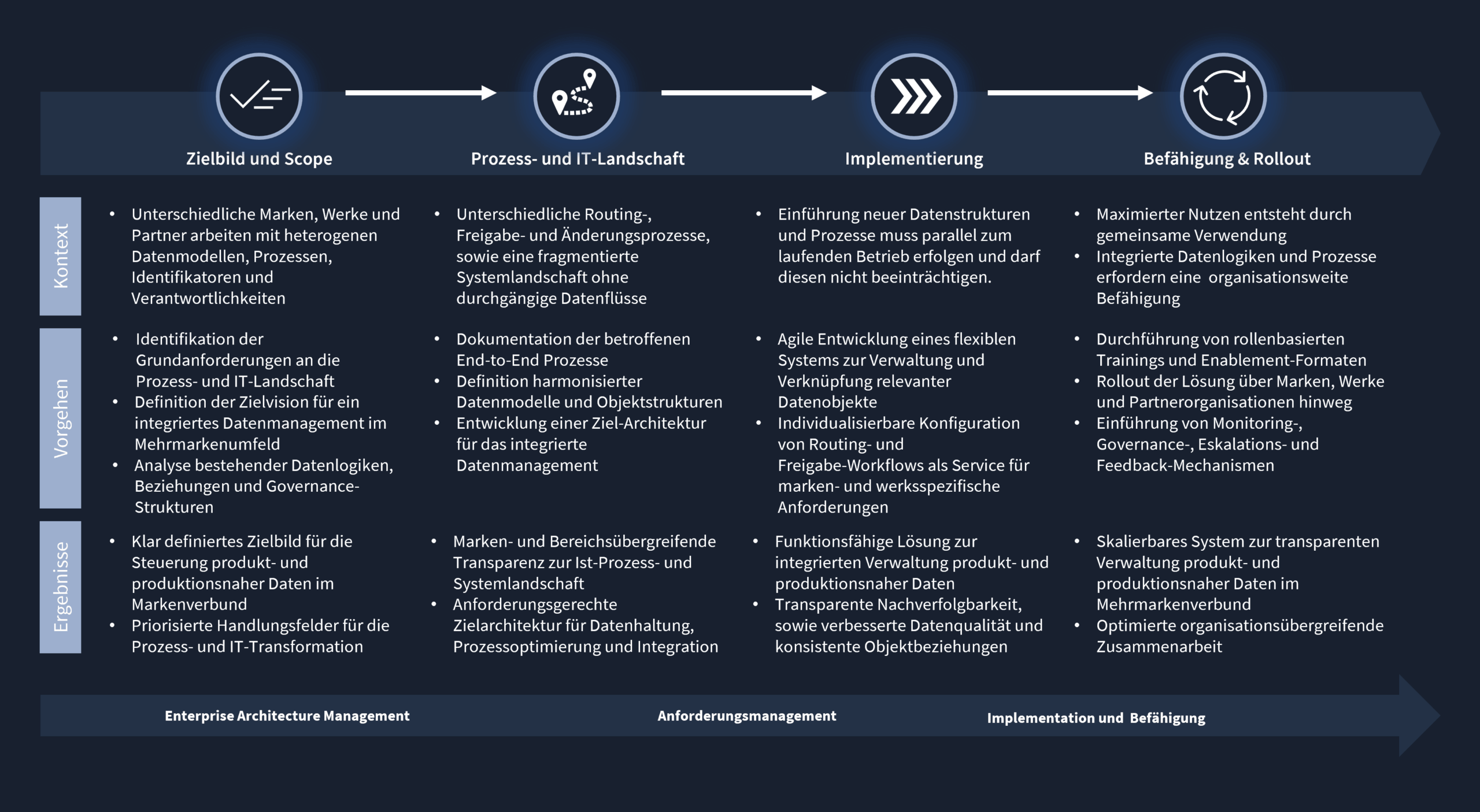
Together, we analyze product logic, network structures, roles, and data sources, and define a robust target framework for your production data management.
We map existing processes, identify inconsistencies, and harmonize data models, attributes, routing logic, and object relationships.
We implement validation rules, configure routing and approval processes, create object relationship logic, and integrate systems.
We train teams, document standards, support implementation, and lay the groundwork for the company to continue developing on its own.
Why Ventum Consulting Is the Right Partner for Product Data Management
Over 20 years of experience
We have in-depth knowledge of the complexity of digital manufacturing and product data, gained from projects in industry and manufacturing.
Holistic Perspective
We integrate processes, systems, data, roles, and governance into a single, integrated solution.
Rapid Value Realization
Iterative implementation, early results, clear quick wins, and measurable effects.
Sustainable Empowerment
We strengthen organizations by establishing clear roles, standards, and support to foster long-term self-sufficiency.
Contact us now at
- Strategic: Harmonization of data logic, stable routing processes, robust object models
- Secure: Transparent Rules, Version Control, and Documented Responsibilities
- Proven in Practice: Experience in a Wide Range of Industries
- Measurable: Focus on Quality, Stability, Lead Time, and Resilience
- Holistic: People, Technology, Data, Governance, and Processes


TISAX and ISO certification apply only to the Munich location
Your message
Take a look at our news










FAQ – Production Data Management
Because production data forms the basis for all manufacturing decisions—from planning to quality control to logistics. Without consistent data, errors, downtime, and coordination efforts arise. Robust data management ensures stability and quality.
In many companies, initial quick wins can be achieved in just a few weeks. Through structured analysis, clear models, and agile implementation, progress becomes visible very quickly. The complete vision usually takes shape step by step and in a scalable manner.
As soon as validation rules take effect, errors decrease significantly because inconsistencies are structurally eliminated. Routing logic becomes more robust, and approvals become more transparent. Improving quality thus becomes a systematic process rather than a matter of chance.
Through training, workshops, clear role models, and transparent standards, teams learn to confidently apply new data logic and develop it further on their own. This makes the organization more resilient and self-reliant.
Through standardized interfaces, APIs, and flexible data pipelines. Existing processes remain intact but benefit from clear, harmonized data structures. This enables a secure, step-by-step digitization of the production data environment.