






- Veröffentlichung:
07.08.2026 - Lesezeit: 11 Minuten
What is AI infrastructure?
Many companies invest in AI models, pilot projects, and use cases—only to run into an unexpected roadblock: their own infrastructure. Without the right technological foundation, AI initiatives get stuck in the prototype stage, incur uncontrollable costs, or fail due to latency, data protection, and compliance issues. Spending on AI infrastructure is growing rapidly worldwide—a clear sign that infrastructure is not a side issue, but rather a strategic competitive factor for resilient, productive operations.
Executive Summary – AI Infrastructure at a Glance
- Strategic Relevance: Companies fear that their AI efforts will fail due to a lack of integration with their core business. The right infrastructure is the key enabler here—without it, any AI strategy remains merely theoretical.
- Growth Momentum: The global market for AI infrastructure is growing rapidly. Companies that fail to set the right course now will fall behind competitors who scaled up earlier.
- Not a run-of-the-mill problem: AI infrastructure is not traditional IT infrastructure. It requires specialized hardware (GPUs, TPUs), distributed architectures, and a combination of cloud, on-premises, and edge computing that must be precisely tailored to the use case.
- Governance and Sovereignty: Data sovereignty, the EU AI Act, and the GDPR are turning AI infrastructure decisions into regulatory choices. Where models run, where data is stored, and who controls it—these are no longer purely technical questions.
- Sourcing is key: Whether you choose a cloud provider, an on-premises setup, or a hybrid model—the right sourcing strategy determines costs, scalability, and control for years to come. Poor decisions are costly and difficult to correct.
What is AI infrastructure?
AI infrastructure encompasses the hardware, software, network resources, and services required for the development, training, deployment, and operation of AI applications. It is the technological foundation that makes it possible to operate models for machine learning, deep learning, generative AI, and agentic AI in a cost-effective manner.
How does AI infrastructure differ from traditional IT infrastructure?
The key differences from traditional IT infrastructure lie in three points:
Computing Power
AI workloads require massive parallel processing. Instead of conventional CPUs, specialized processors such as GPUs (graphics processing units) and TPUs (tensor processing units) are used, which perform matrix and tensor calculations orders of magnitude faster.
Data Architecture
AI applications rely on large volumes of high-quality data. The infrastructure must combine scalable storage (data lakes, data warehouses, distributed file systems) with high-performance pipelines for data preparation, training, and inference.
Distributed Hybrid Architectures
AI infrastructure rarely follows the traditional “everything in our own data center” model. The cloud, on-premises systems, data centers, and the edge are all interconnected—depending on where data is generated, where training takes place, and where inference must occur.
What are the key components of a modern AI infrastructure?
A robust AI infrastructure consists of several coordinated layers. Each layer has a clear function—and every incorrect decision affects overall performance.
Hardware Level
- GPUs & TPUs: Specialized processors for parallel computing, essential for model training and inference.
- Specialized Servers & Clusters: From cloud servers to AI-optimized mainframes to edge devices—depending on the use case.
- AI data centers: Facilities with specific energy, cooling, and network capacity designed for AI workloads.
- Storage Infrastructure: Scalable systems for training data, models, and inference results.
Network Layer
- High-performance switches and routers for low latency and high bandwidth.
- Secure connections between the cloud, on-premises, and the edge.
- 5G (and beyond) and private networks for edge AI scenarios.
Software Layer
- ML frameworks: TensorFlow, PyTorch, and similar tools for model development.
- MLOps and AIOps platforms: For automation, monitoring, CI/CD, and scaling the AI lifecycle.
- Optimization software: Inference servers and frameworks for efficient model execution.
- Security tools: Encryption, access control, AI-specific threat detection.
Service Level
- AI-as-a-Service (AIaaS): Preconfigured AI functions via APIs, without the need to develop your own models.
- Managed Services: Operation, maintenance, and optimization by specialized partners.
- Consulting and Enablement Services: For organizational adoption.
Cloud, on-premises, edge, or hybrid—which deployment model is right for your business?
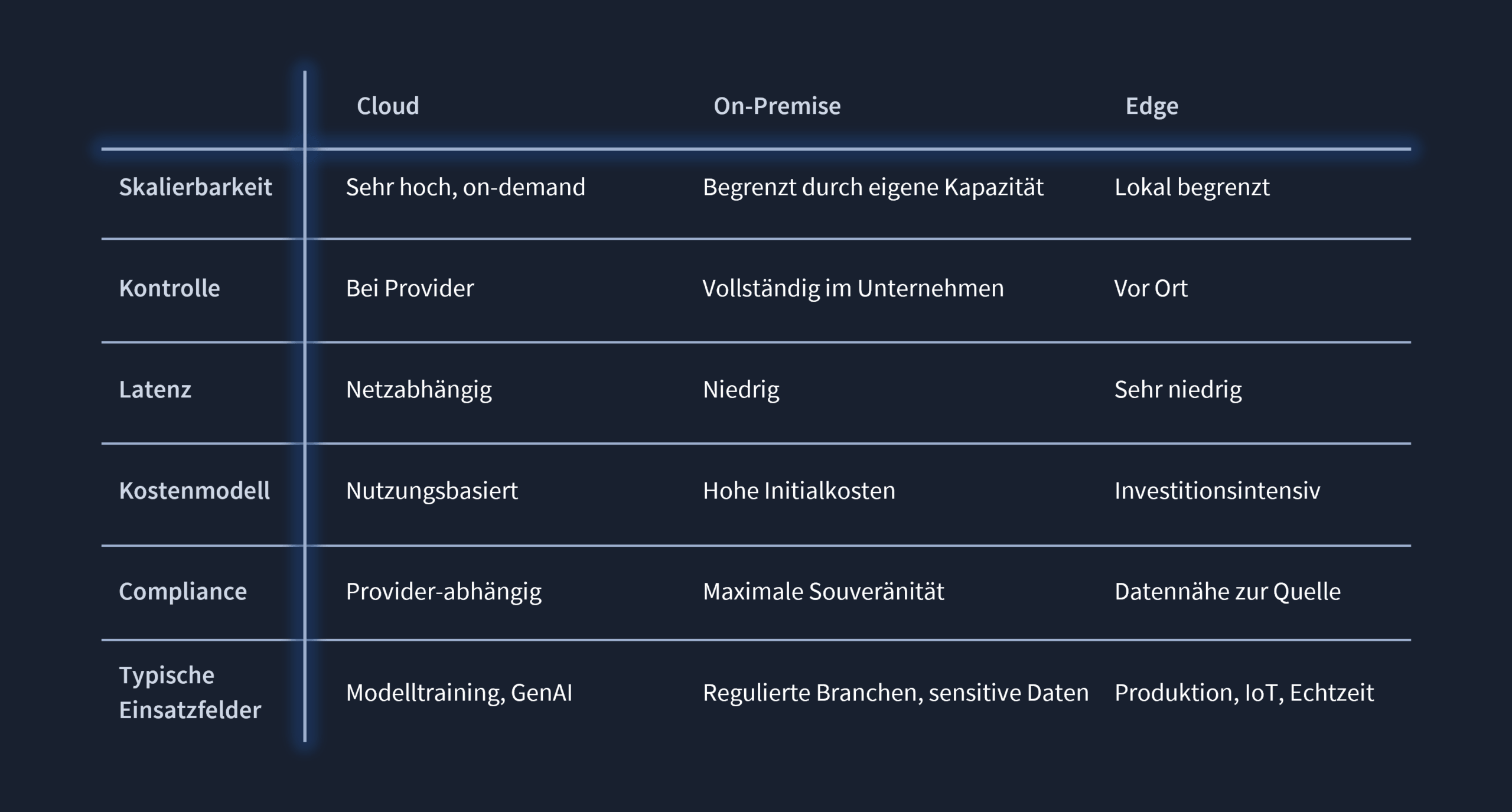
Choosing a deployment model is one of the most significant decisions when building AI infrastructure. It affects costs, scalability, data control, and regulatory compliance for years to come. Most companies today rely on hybrid models—the cloud for scalable training, on-premises for sensitive workloads, and the edge for real-time inference. What matters is not the model itself, but the right combination tailored to specific use cases.
How to Strategically Source AI Infrastructure.
Building an AI infrastructure is, to a large extent, a sourcing decision. GPU capacity, cloud services, specialized managed service providers, data center space—the options are vast, and the long-term consequences of each decision are significant.
Common mistakes:
- Lock-in to a single cloud provider without an exit strategy
- Failure to Comply with Data Sovereignty and Regulatory Requirements
- Lack of transparency regarding actual usage costs (FinOps)
- SLAs that do not meet the specific requirements of AI workloads
Our IT sourcing consulting service combines strategic sourcing expertise with a deep understanding of AI infrastructure and applications. We operate independently, evaluate vendors objectively, and guide you through every step of the process—from needs analysis to the request for proposals and contract negotiations.
Why AI Infrastructure Is Becoming a Strategic Priority.
AI Sovereignty Is Becoming a Competitive Factor
Companies increasingly want to retain control over their models, data, and processing paths—for regulatory, economic, and strategic reasons. “Where are our AI workloads running?” has become a strategically important question.
Regulatory requirements mandate traceability
The EU AI Act, the GDPR, and industry-specific requirements—for example, in the financial, healthcare, and public sectors—compliance starts with the infrastructure. Anyone who cannot document data processing and model deployment in a traceable manner risks fines and reputational damage.
Agentic AI is changing the requirements
Autonomous AI agents that plan, make decisions, and take action place fundamentally new demands on computing power, networks, and governance. Traditional IT architectures are reaching their limits—AI infrastructure must be designed from the ground up for these workloads.
Your Experts in AI Infrastructure


Our AI Infrastructure Consulting Services
Ventum Consulting provides comprehensive support to companies as they build an AI infrastructure that is technologically robust, economically sound, and compliant with regulatory requirements. Our services cover the entire process, from strategic assessment to day-to-day operations.
AI Infrastructure Strategy & Vision
Requirements and Maturity Level Analysis
Sourcing Strategy for AI Infrastructure
Architectural Design & Technology Selection
Governance, Compliance, and AI Security
Implementation & Migration
Operation, Optimization, and Scaling
Why Choose Ventum Consulting for AI Infrastructure
: Over 1,500 Projects Completed
Large corporations and small and medium-sized businesses rely on our experience because we deliver what we promise—time and time again.
Over 20 Years of Consulting Expertise at
We know the pitfalls and the shortcuts—so you can get where you’re going faster.
100% Dedicated to Your
Business Success
We aren’t satisfied until you are, because it’s the measurable results that count. That’s how we measure our success.
AI Consulting &
s Governance
From use case identification to implementation to governance—all from a single source.
+1,500 projects completed
Over 20 Years of Consulting Expertise
100% Dedicated to Your Business Success
AI Consulting &
s Governance
- Talk directly with subject matter experts—no sales team involved
- Free Assessment of Your Situation and Needs
Arrange a non-binding initial consultation now
- Future-Oriented: Leveraging AI Infrastructure as a Strategic Growth Driver
- Tailor-Made: Custom Architectures Instead of Standard Setups
- Proven: Over 20 Years of Expertise in Successful Projects
- Independent: Manufacturer-neutral advice focused on your needs
- Strong in Implementation: From Strategy to Operations—All Under One Roof


TISAX and ISO certification apply only to the Munich location
Your message
Take a look at our news










FAQ – Frequently Asked Questions About AI Infrastructure
It depends on the use case. For training large models, the cloud is often the most practical option. For sensitive data, real-time inference, or regulated industries, on-premises or edge setups are often essential. Most companies are best served by hybrid models.
The range is enormous—from lean, cloud-based pilot projects to large-scale investments in dedicated AI data centers.
The EU AI Act requires traceability regarding model origin, training data, and processing paths. This has direct implications for the infrastructure: logging, lineage tracking, access control, and the ability to document processes must already be embedded in the architecture.
AI sovereignty means retaining control over one’s own models, data, and processing methods—regardless of individual providers or jurisdictions. For European companies, this is increasingly becoming a necessity for regulatory and strategic reasons.
AIaaS refers to cloud-based services that provide AI capabilities via APIs—without the need to develop your own models. While this is a practical starting point for many use cases, it is rarely the final solution for strategic AI applications.
We provide independent consulting services ranging from vision development to vendor selection and operational implementation—combined with our expertise in sourcing and AI consulting. We are not tied to any specific manufacturer and focus on creating value for you.
Depending on the initial situation, the first productive setups can be implemented in just a few weeks—usually cloud-based and tailored to specific use cases. Building a company-wide, scalable AI infrastructure is a program that grows iteratively and in a use-case-driven manner over an extended period of time.