





- Veröffentlichung:
01.08.2025 - Lesezeit: 11 Minuten
What is a data strategy – and why do companies need one right now?
According to a study by bitkom, 9 out of 10 companies in Germany describe themselves as “data-oriented”. At the same time, only 36% of these companies actually have a data strategy. Even more drastic: almost half (47%) diligently collect data, but never analyze it. This paradox is not a statistical coincidence – it reflects an illusion that is particularly widespread in German industry. While companies believe they are already on the right track, they are missing the decisive steps towards real data utilization – a data strategy.
Why is this becoming a problem right now? 82% of industrial companies agree that the use of artificial intelligence will be decisive for the competitiveness of German industry in the future. However, without a clear data strategy, there is no basis for implementing AI projects sustainably, because the competition can also buy any AI tool – the decisive advantage only arises through integration into the company. The right data and working models are essential for this and must be anchored in the data strategy, otherwise AI will remain an untapped potential and increase the competitive risk.
What is a data strategy? - Definition and basics
A data strategy is a systematic plan that defines how a company collects, manages, analyzes and uses data to achieve business goals. It determines what data is required, how it is stored and processed and who has access to it.
The core elements of a data strategy
- Area: Rules and responsibilities for data availability, quality and security
- Goal: Ensure that data is available, trustworthy, up-to-date and consistent across the company
Central questions:
- Who is responsible for which data (data owner vs. data steward)?
- How do we define data quality standards?
- Which processes ensure that data remains up-to-date?
- How do we resolve conflicts with contradictory data sources?
- What is the specific working model for data requests and supply?
- How is the success and value of data use cases measured?
- Area: Technical infrastructure for integration, processing and provisioning
- Goal: Create a scalable, flexible and automated infrastructure that integrates various data sources and supplies the data use cases
Central questions:
- Which data sources need to be integrated (ERP, MES, CRM, IoT sensors)?
- Do we need a data warehouse, data lake or a hybrid solution?
- How do we ensure real-time processing?
- Which cloud vs. on-premises strategy are we pursuing?
- Area: Methods for gaining knowledge from existing data
- Goal: Generate business-relevant insights and make data-based decisions
Central questions:
- Which KPIs and metrics are critical for our business?
- Do we need descriptive, predictive or prescriptive analyses?
- Which tools and methods (BI, machine learning, AI) do we use?
- How do we make findings accessible to decision-makers?
- Area: Compliance with legal and regulatory requirements (GDPR, industry standards)
- Goal: Meet all legal requirements and thus minimize risk and create trust
Central questions:
- How do we implement GDPR-compliant processes?
- Which industry-specific regulations apply (FDA, ISO standards)?
- How do we document the origin and use of data?
- What security measures protect against data misuse?
- How will Need2Know requirements be balanced with Want2Share principles?
- Area: Cultural change towards data-driven decisions and company-wide data exchange
- Goal: Establish a data-driven corporate culture
Central questions:
- What training do our employees need?
- How do we create acceptance for new data-based processes?
- Which incentive systems promote data-driven work?
- How do we organize the “early adopters” and promote rapid acceptance throughout the organization?
Data governance defines workflows and quality standards, data architecture ensures technical implementation, data analysis generates business value, compliance protects against risks, and change management ensures that people actually use the new opportunities.
Without one of these elements, the entire strategy will fail. Even the best analysis is useless if the data quality is poor. Even the most modern architecture is useless if employees do not know how to work with it.
Differentiation from other digital transformation strategies
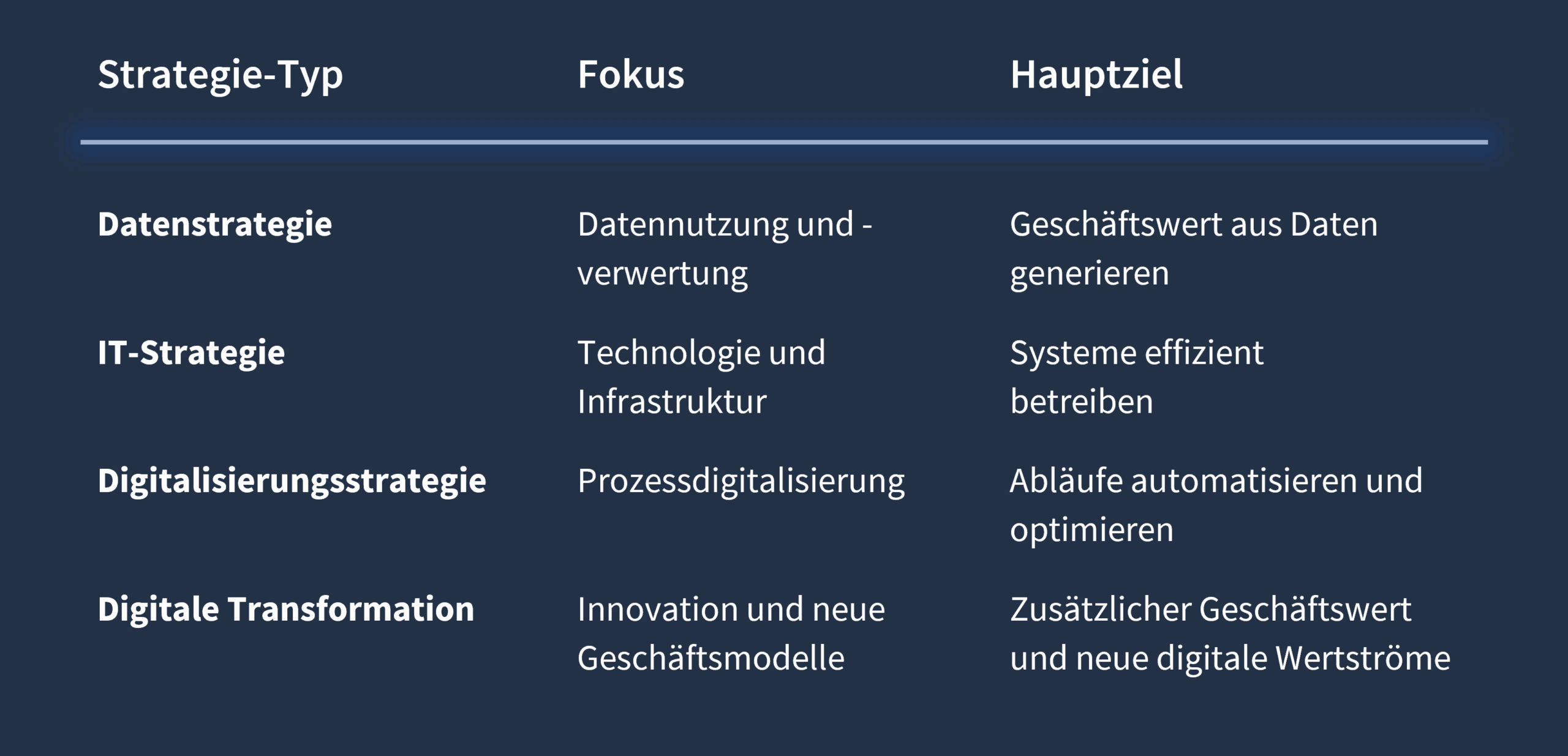
The four strategies differ in their approach to value creation: while IT strategies focus on technological efficiency and digitalization strategies accelerate processes and reduce costs, data strategies open up completely new insights and business opportunities. Digital transformation also aims to open up new digital value streams that could not be achieved using traditional business models.
Why is a data strategy important?
A data strategy is a systematic approach to the optimal use of your company data. It creates the basis for data-driven decisions and sustainable business success. The most important advantages of a data strategy:
Gartner studies show that poor data quality costs companies an average of 12.9 million dollars a year.
Coordinated working models enable efficient and fast access to data – even beyond organizational boundaries or even between different organizations
Structured data significantly reduces the time required for data preparation.
Uniform standards prevent costly data silos and redundant system landscapes.
Quality-assured data enables decisions to be made in the shortest possible time.
Clean data foundations are a prerequisite for successful AI implementations.
Clear data architectures enable the seamless integration of new tools.
Clear data responsibilities and processes minimize the risks of GDPR penalties
Investments in data tools require a data strategy in order to offer the full added value.
Companies with a mature database discover potential for increasing operational efficiency more quickly.
Structured data usage creates long-term differentiation from the competition.
Why data strategies fail in practice
German industry is facing a dilemma: while 42% of companies are already using AI in production, just as many are struggling with fundamental problems and a lack of expertise in data strategy implementation.
It is not only the internal shortage of AI specialists that plays a major role here – according to the Computerwoche study from 2023, failed change management, operational implementation and quality problems are considered to be the main disruptive factors for employees.
Only 5% of those surveyed stated that there were no challenges on the way to becoming a data-driven company.
- 34% complain about the lack of a data-oriented mindset among colleagues, especially in large companies and corporations
- 22% see an unsuitable corporate culture as an obstacle
- 47% collect data but do not analyze it
- 20% suffer from too many data silos
- 28% are hindered by complicated software applications
- Only 26% of companies have introduced data management – 51% rate their data management as poor
- There are similar concerns about data transparency, consistency and completeness
Types of data strategies at a glance
Strategic orientation
Organizational model

Readiness for analysis
Data strategy as the foundation for AI success
The figures speak for themselves: 79% of German industrial companies see AI as crucial for a pioneering role, and 82% are convinced that AI will determine their competitiveness in the future. However, 42% still report a lack of expertise in AI integration and as many as 50% of the companies surveyed are waiting to see what others do. (Study: bitkom)
Without solid data foundations, AI projects fail not because of the technology, but because of fundamental problems that affect all core elements of a data strategy: inconsistent data quality, lack of governance, unclear responsibilities. A data strategy lays precisely these foundations. It is the difference between AI pilot projects that fizzle out and scalable solutions that create real business value.
So if you want to be successful with AI, you first need to get your data in order. A data strategy is not optional – it is the ticket to an AI-driven future.
What does it cost not to have a data strategy?
The costs of a lack of data strategy are measurable. While companies with a clear data strategy benefit over their competitors, according to Gartner studies, poor data quality costs companies an average of 12.9 million dollars a year. These enormous losses are caused by wrong decisions due to incorrect data, duplication of work due to inconsistent systems and missed business opportunities due to a lack of insights. Another study by prove shows that companies with high-quality data management achieve up to 66% more turnover.
Compliance risks can also cause massive costs for companies. GDPR penalties can amount to up to 4% of annual global turnover. Without a data strategy, the risk of compliance violations increases exponentially.
However, the effects are particularly noticeable when it comes to AI. While 42% of German industrial companies are already using AI technologies in production, most are failing due to fundamental data problems and a lack of expertise in AI integration – often a direct result of a lack of data strategy and a lack of data strategy consulting.
The hard truth: A lack of data strategy doesn’t just cost money – it potentially costs the future of your company.
Kick-start to a data-driven company - your basis for AI, data-driven use cases & knowledge management
Turn raw data into tangible value: with our tried-and-tested kick-start program, you can lay the foundations for sustainable, data-driven transformation in just a few weeks.
- Individual structural framework with integrated use case blueprint
- Quick project start thanks to preliminary analysis, tried-and-tested templates and best practices
- Uniform integration approach for synergies and scalable modules
- Precise gap analysis for immediate skills and resource development
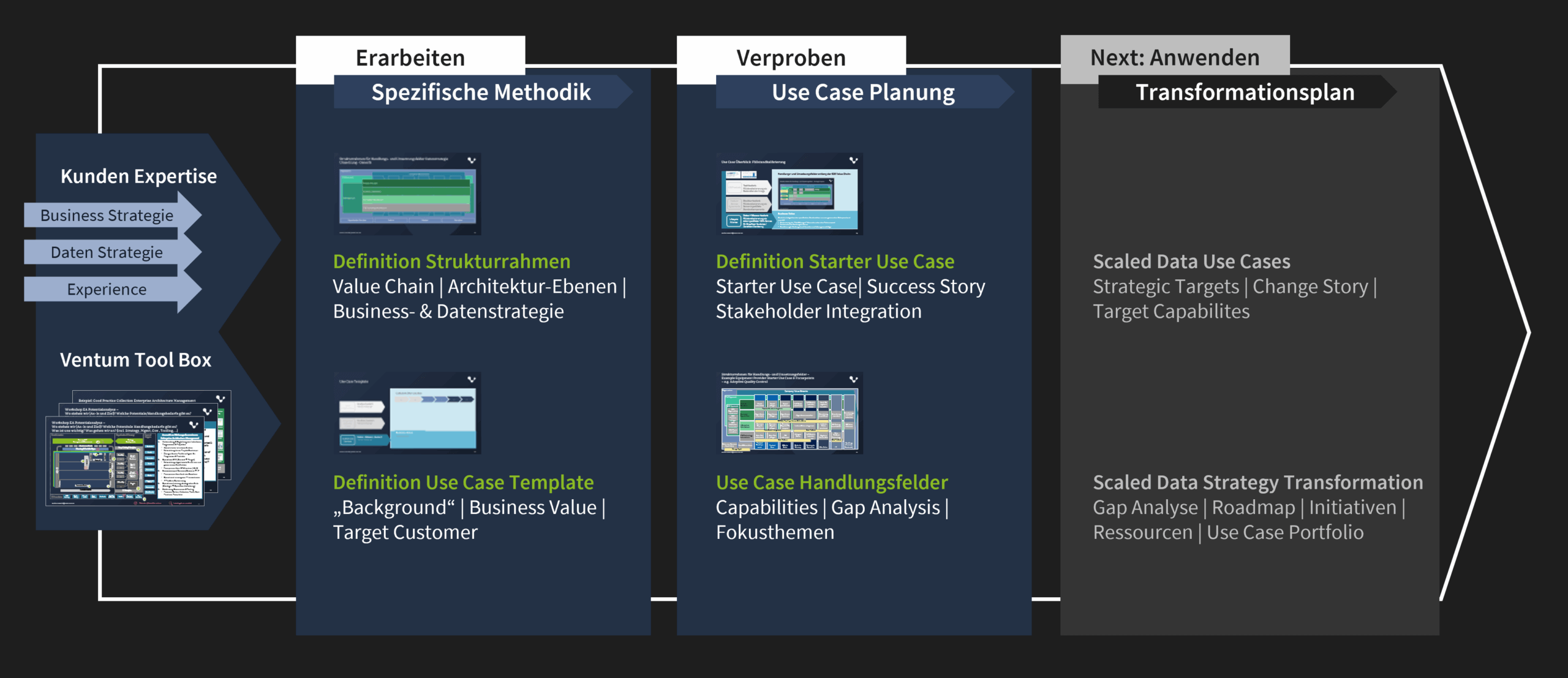
In line with the principle of “think big, start small”, we rely on a tried-and-tested toolbox of methods and practice-oriented expertise: together, we develop a tailored structural framework, test it with a focused pilot use case and transfer the insights gained to your strategic data initiatives. This creates a resilient framework for designing and planning your most important areas of transformation – efficiently, iteratively and with guaranteed impact.
Conclusion: Your data strategy determines your success
Numbers don’t lie: companies with a well-thought-out data strategy pull ahead, while others sink into data chaos and lose potential revenue every year. The three decision-making dimensions – strategic orientation, organizational model and analytical maturity – are not a theoretical construct, but the practical blueprint for your success.
A data strategy does not develop by itself. It requires clear decisions, a structured approach and often external expertise to help you navigate the complexity. The good news: you don’t have to start from scratch. Start today:

01

02

03
Your partner for data strategy

Arrange a non-binding initial consultation now
- Future-oriented: Targeted use of data as a growth driver
- Tailor-made: Individual solutions for your specific challenges
- Tried and tested: 20 years of practical experience from successful data projects guarantees reliability
- Strong implementation: from conception to measurable realization of results
- Value-oriented: Clear focus on sustainable benefits and real competitive advantages
TISAX and ISO certification for the Munich office only