






- Veröffentlichung:
06.08.2026 - Lesezeit: 8 Minuten
Using AI Agents in Compliance with Data Protection Regulations and Legal Requirements
Executive Summary – Using AI Agents in Compliance with Data Protection Regulations and Legal Requirements
- Strategic Importance: AI agents are fundamentally transforming processes—but without governance, data protection, and clear lines of responsibility, significant regulatory and operational risks arise.
- Operational Benefits: Companies automate multi-step tasks, reduce manual work, and create scalable digital processes with traceable controls.
- Security & Compliance: Through a structured EU AI Act assessment, GDPR compliance, and technical guardrails, autonomous agents become controllable and auditable.
- Production-ready: What matters is not the pilot phase, but the smooth transition to actual production operations.
- Success Factors: Governance, Human-in-the-Loop, Audit Trails, Open Architecture, and Clear Role Models.
Challenges - Why Many AI Agent Initiatives Fail
Many companies are already experimenting with agent-based AI systems, but never make it to production. The bottleneck rarely lies in the technology itself, but rather in a lack of process maturity, unclear responsibilities, and a lack of regulatory clarity. The situation becomes particularly critical as soon as agents make decisions independently, process data, or carry out operational actions—because that is when the requirements of the EU AI Act, the GDPR, and other compliance frameworks come directly into play.
Without governance, uncontrolled automation, shadow processes, and security vulnerabilities can quickly arise. Teams build isolated agent solutions that cannot be documented or operated in a traceable manner. At the same time, the technology’s true potential remains untapped because productive scaling fails to materialize and pilot projects never transition into stable operation.
Consequences - what becomes visible in production & work preparation
- Pilot projects remain in experimental mode indefinitely and do not deliver any real business impact
- Responsibilities for autonomous decisions are unclear or undocumented
- High-risk classifications under the EU AI Act are identified too late
- Repetitive manual processes continue to tie up resources
- Shadow automation is emerging unchecked outside of defined governance structures
- The lack of audit trails makes it difficult to provide evidence and ensure regulatory compliance
- Proprietary architectures create long-term lock-in risks

Your Contacts for Using AI Agents in a Way That Complies with Data Protection Laws and Is Legally Sound


Our Solution — Scaling AI Agents Safely, in a Controlled Manner, and Productively
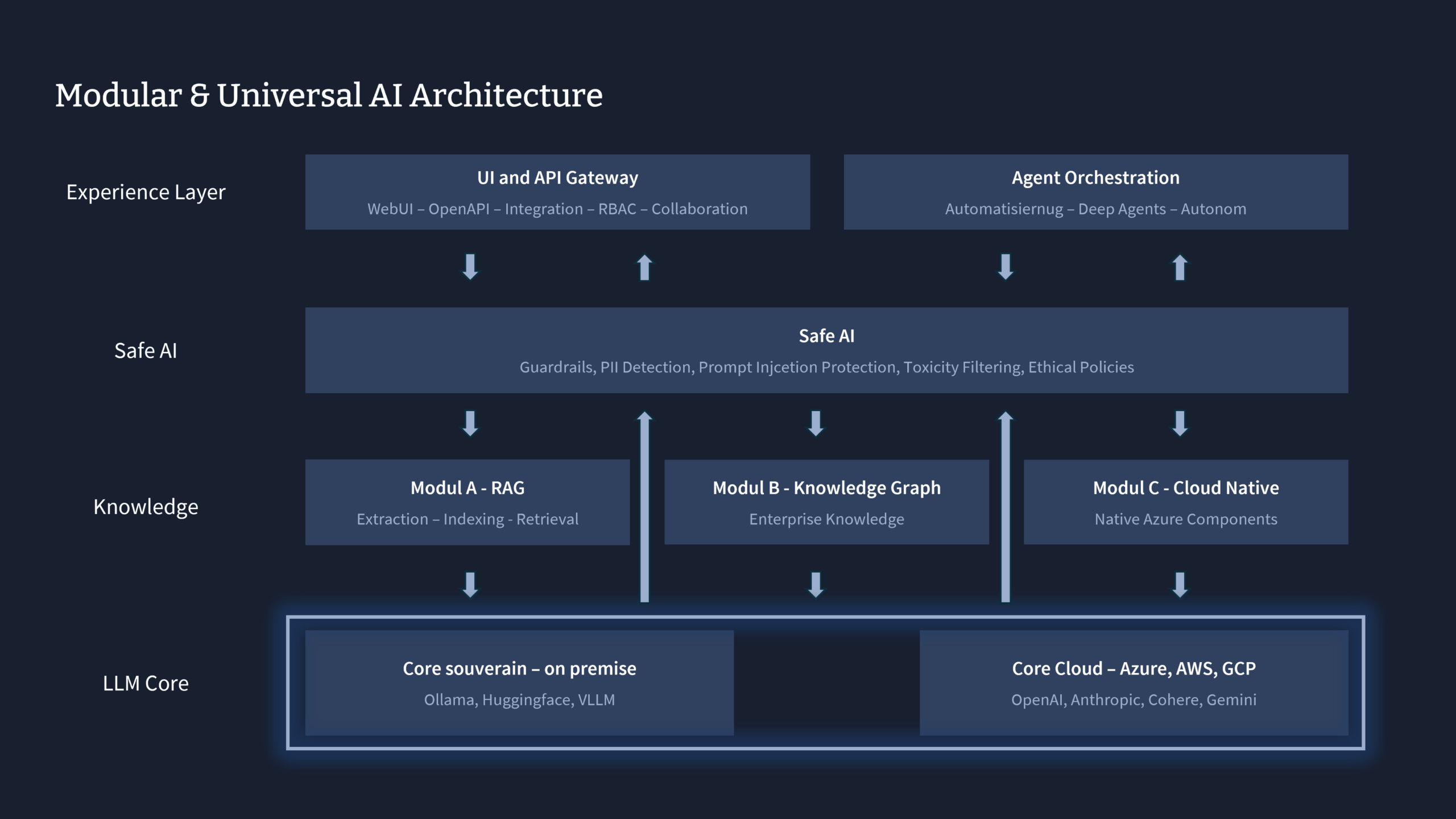
With the Sovereign AI Platform expand we AI not only around Knowledge, but around controlled Take action. Agents take over multi-stage Tasks, orchestrate Processes and interact directly with existing Systems such as ERP, CRM or Service Platforms — however always within clear more defined Governance Limits. Any Plot will be monitored, logged and understandable done.
Basis for that is a individual Assessment, that the entire Path by the first Assessment of the Current Situation until to the productive Operation structured accompanied. We classify in the process every Use Case according to EU AI Act, rate the organizational and technical Process Readiness and accompany Company throughout until in the Production operation. Our Architecture is based on at open Standards such as MCP and avoids proprietary Lock-ins. Company received with it not only one technical Platform, but a durable Operating Model for secure, productive Agentic AI systems.
Benefits at a Glance
- Safe and Controlled Adoption of Agent-Based AI
- Clear Responsibilities and Governance Models
- Early Compliance with the EU AI Act and Risk Mitigation
- Traceable audit trails for every agent action
- Fewer manual processes and greater operational scalability
- Open, interchangeable architecture without platform lock-in
- Sustainable transition from a pilot project to full-scale operation
Every engagement begins with a structured assessment that maps out existing processes, data landscapes, maturity levels, and regulatory frameworks. From this, we develop a customized approach that continuously guides and validates all subsequent phases, from defining governance to scaling. This results in a customized roadmap tailored to the company’s specific risks, requirements, and goals.
We analyze processes, roles, and decision-making structures and define a robust target framework for the safe deployment of autonomous AI agents. In doing so, we assess risks, regulatory classifications, and organizational requirements at an early stage.
We are developing an open, interchangeable agent architecture with clear interfaces to ERP, CRM, DMS, and other core systems. Data protection, traceability, and technical security are at the heart of this effort.
We integrate decision-making guardrails, human-in-the-loop approvals, and complete audit trails into every critical process. This ensures that autonomous systems remain controllable and auditable.
We help teams build operational capabilities, establish governance roles, and lay the groundwork for the scalable, sustainable use of agent-based AI systems.
Why Ventum Consulting Is the Right Partner for Using AI Agents in a Way That Complies with Data Protection Regulations and Is Legally Sound
Over 20 years of experience
We combine technology, governance, and transformation expertise with a deep understanding of the regulatory realities facing businesses.
Open Architecture
Our solutions are based on open standards and avoid long-term dependencies on individual platform providers.
Regulatory security
We take the EU AI Act, the GDPR, and auditability into account from the very beginning—not just after the pilot project.
Scalable Governance
We create operational models that remain manageable and transparent even as the number of agents grows.
Contact us now at
- Strategic: Governance , Architecture, and Productive Agentic AI Transformation
- Secure: Agent Systems Compliant with the EU AI Act, GDPR, and Compliance Requirements
- Proven in Practice: Experience with AI Governance, Enterprise Architectures, and Process Automation
- Measurable: Focus on scalability, process optimization, and secure go-live
- Holistic: people, technology, data, governance & processes

TISAX and ISO certification apply only to the Munich location
Your message
Take a look at our news










FAQ – Using AI Agents in Compliance with Data Protection Laws and Legal Requirements
As soon as an agent makes decisions independently or influences critical processes, a high-risk classification may become relevant. Systems that affect people, rights, or security-related processes are particularly affected. Therefore, an early regulatory assessment is crucial.
Often, there is a lack of clear governance, a robust process structure, or a realistic transition to production. Teams test isolated solutions without considering security, role, or compliance models. This results in technical silos that offer no sustainable added value.
Through human-in-the-loop approvals, defined autonomy limits, and complete audit trails. Every critical action must be documented in a traceable manner. This ensures that responsibility remains transparent and manageable at all times.
Agents often work with sensitive personal or business-critical data. For this reason, data protection, access control, and secure data processing must be taken into account at the architectural level. Privacy by design is not an option—it is a prerequisite.
Only if governance, roles, data quality, and operational processes are defined early on. Successful organizations establish MLOps and AgentOps structures before scaling up. This transforms a proof of concept into a robust operational model.
Through open standards, modular architectures, and clearly defined interfaces. Companies should ensure that agents remain interchangeable and are not completely tied to individual vendors. This ensures long-term flexibility and technological autonomy.
New roles such as agent supervisor, AI governance lead, and oversight manager are becoming more important. At the same time, responsibilities are shifting from manual execution to management, oversight, and quality assurance. Companies therefore need not only technology but also an adapted operating model.