






- Veröffentlichung:
05.08.2026 - Lesezeit: 12 Minuten
Data Mesh Consulting: Decentralizing Data Responsibility – Scaling Value Creation
Companies have invested in centralized data platforms, data lakes, and cloud infrastructures—yet they still face the same problems: business units are waiting for data, centralized data teams are becoming a bottleneck, and AI initiatives fail not because of the model itself, but due to poor data quality and lack of availability. The reason rarely lies in the technology. It lies in the architecture and the organizational model. Data Mesh resolves this contradiction through a decentralized, domain-oriented data architecture in which business units take responsibility for their data products and make them available across the enterprise via a shared platform and unified governance. The result: faster analytics, better data quality, true scalability, and a data foundation that not only enables artificial intelligence but also makes it productive. Our Data Mesh Consulting combines architectural expertise with organizational depth: We support companies from strategic assessment through domain design and platform architecture to sustainable embedding within the organization.
Executive Summary - Data Mesh at a Glance
- The scaling problem is structural, not technical: Despite investments in cloud platforms, data lakes, and BI tools, companies are slowing down because the bottleneck lies not in the infrastructure but in the organizational model of central data teams, which can no longer meet the growing demand.
- Ownership is the most powerful driver of data quality: Most quality issues arise at the source due to a lack of accountability—Data Mesh shifts ownership to where the domain expertise lies.
- Treating data as a product changes everything: The paradigm shift from a pipeline to a data product with SLAs, quality standards, and measurable value is at the heart of Data Mesh and lays the groundwork for maximum analytical value and scalable AI.
- The principles have taken hold—but not in their purest form: Domain ownership, data products, and self-service are now integral parts of virtually every viable data strategy—often referred to as “data products” or “AI-ready data”—but what proves viable are tailored, hybrid models rather than complete, textbook-style decentralization.
- Regulation is increasing the pressure for clear data accountability: The EU AI Act, Data Act, and DORA require verifiable transparency, auditable lineage, and defined responsibilities—which is precisely what federated governance achieves structurally, rather than enforcing compliance retroactively through centralized controls.
- The limiting factor is the organization, not the platform: Data Mesh requires new roles, changed collaboration models, and targeted empowerment of business units, with domain data owners and data product managers being operational prerequisites rather than optional additions.
Our Data Mesh Consulting Services: Six Areas of Focus for Scalable Data Architectures
A successful data mesh transformation is driven by six areas of focus that are interrelated from both a technical and organizational perspective. Two of these form the strategic foundation: domain design and federated governance. They do not merely enable individual solutions, but rather lay the groundwork for all current and future analytics and business applications within the company.
01 – Domain Design & Data Product Definition
02 – Federated Data Governance
03 – Self-Service Platform & Cloud Infrastructure
04 – Data Integration & Interoperability
05 – Data Quality & Data Product Management
06 – Organization, Roles & Enablement
What Ventum Consulting's Data Mesh Consulting Services Specifically Offer You
Faster Time-to-Data for Your Business Units
Business units have direct access to quality-assured data products—without having to go through central teams. This accelerates analytics, reporting, and AI initiatives across the entire company.
Higher Data Quality Through Clear Ownership
New domains, use cases, and analytics requirements can be integrated without central data teams becoming a bottleneck. Your data architecture grows with your business.
Scalability without a central bottleneck
New domains, use cases, and analytics requirements can be integrated without central data teams becoming a bottleneck. Your data architecture grows along with your business.
Regulatory Certainty Through Federated Governance
Uniform standards for metadata, access rights, and lineage—implemented decentrally, orchestrated centrally. This enables you to meet the requirements of the GDPR, the Data Act, and the EU AI Act in a verifiable and auditable manner.
Data Mesh consulting doesn't start with technology, but with the question of who is responsible for the data
A common mistake: Companies treat Data Mesh as a technical architecture project and start by evaluating platforms and selecting tools. The result: costly infrastructure without organizational buy-in, and business units that continue to wait for central teams.
The difference is crucial:
A new data platform is changing where data is stored. It is modernizing the infrastructure.
Data Mesh fundamentally changes how data is managed, delivered, and consumed. It represents a paradigm shift in data management—from centralized control to domain-oriented ownership, from monolithic pipelines to standalone data products, and from gatekeeper models to self-service with unified governance.
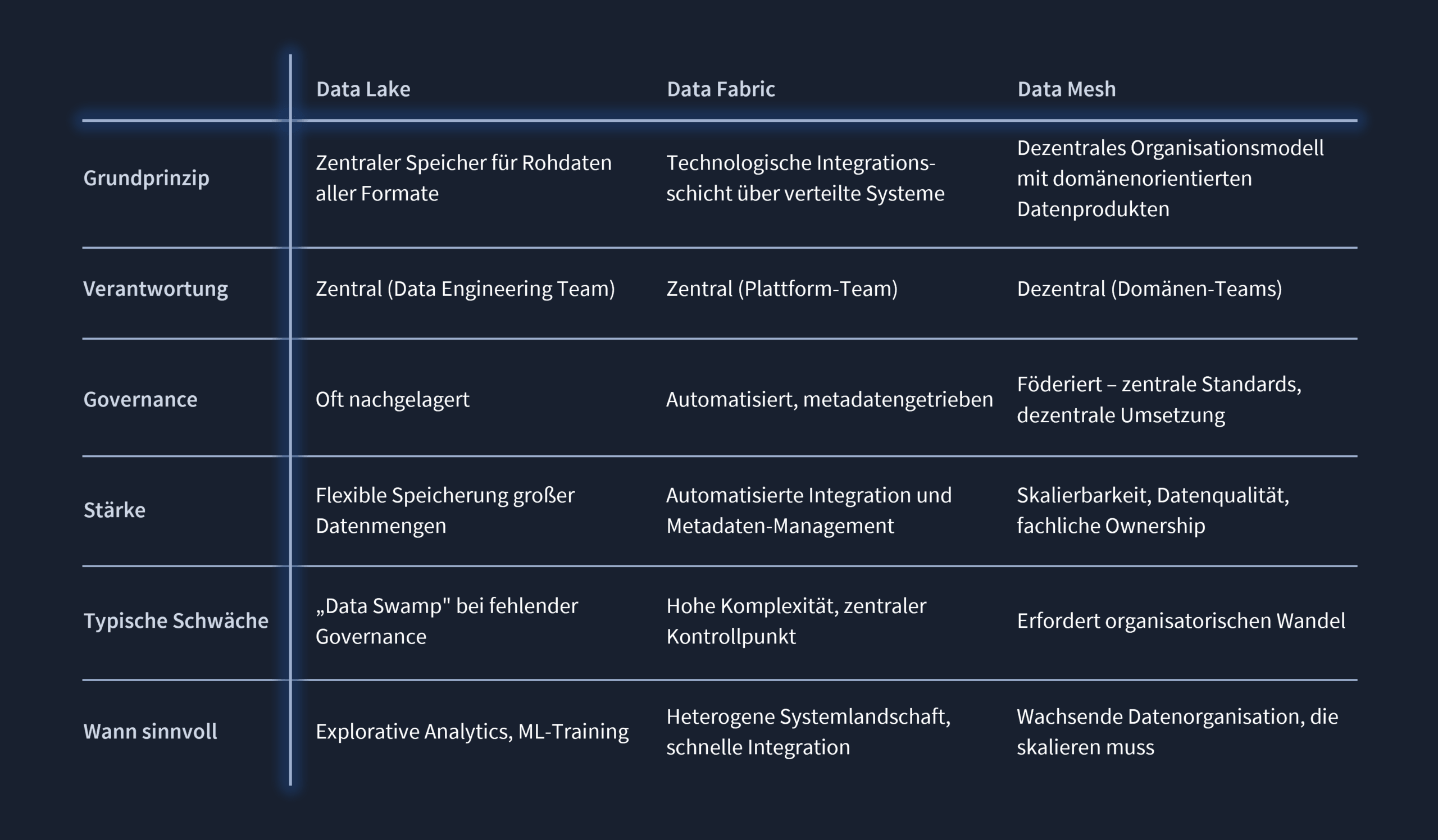
Our Consulting Expertise: Data Mesh, Data Lake, and Data Fabric—Which One Is Right for Your Business?
These terms are often confused or used interchangeably. In practice, they describe fundamentally different approaches—which can, however, complement one another.
Your Experts in Data Mesh Consulting

Data Mesh in Practice: What Has Worked—and What Hasn't
Data Mesh is no longer a new concept. Since its initial publication in 2019 and the seminal work of 2022, several years of practical experience have been gained—in large corporations, upper-mid-market companies, and digital enterprises. This experience is more nuanced than the textbook version suggests. We base our consulting services on what has actually proven to be viable during this time.
The core principle has proven effective: placing responsibility for data where the subject matter expertise lies. Treating data as a product—with a defined interface, a quality guarantee, and a designated owner. And a platform that allows domain teams to work independently. These principles are now an integral part of virtually every viable data strategy—regardless of whether the initiative is called “Data Mesh.”
Data Mesh Consulting—From Hype to Craft: Data Products, Data Contracts, and AI-Ready Data
Anyone currently setting up a data architecture works with these building blocks:
Data Products & Data Contracts
The principle of “data as a product” has evolved into a verifiable artifact: The Data Contract defines the schema, semantics, quality guarantees, and responsibilities—all versioned and machine-testable. This is the most tangible and enduring legacy of Data Mesh.
AI-Ready Data
The same issue that is driving investment today: For AI applications and agents to work reliably, they need well-documented, quality-assured, and discoverable data with clearly defined accountability. Data products are the answer.
Semantic Layer & Knowledge Graphs
Language models and agents do not fail because of tables, but because of a lack of domain-specific meaning. A semantic layer makes business logic machine-interpretable and has thus become a prerequisite for reliable AI applications based on enterprise data.
Platform Engineering for Data
The self-service principle has been integrated with the platform engineering approach: The data platform itself is managed as a product—with templates, standardized workflows, and internal users.
Active Metadata & Federated Governance
Metadata-driven, largely automated enforcement of policies: the realistic, achievable-in-stages version of what theory describes as “computational governance.”
For your project, this means: The question isn’t whether you should “implement Data Mesh.” The question is which of these building blocks your maturity level, your organization, and your use cases actually require—and in what order. That’s exactly where our consulting services come in.
Why Choose Ventum Consulting for Data Mesh Consulting?
: Over 1,500 Projects Completed
Large corporations and small and medium-sized businesses rely on our experience because we deliver what we promise—time and time again.
Over 20 Years of Consulting Expertise at
We know the pitfalls and the shortcuts—so you can get where you’re going faster.
100% Dedicated to Your
Business Success
We aren’t satisfied until you are, because it’s the measurable results that count. That’s how we measure our success.
Strategy through
Implementation
Everything from a single source—so there are no gaps between concept and impact that cost time and money.
+1,500 projects completed
Over 20 Years of Consulting Expertise
100% Dedicated to Your Business Success
Strategy through
Implementation
- Talk directly with subject matter experts—no sales team involved
- Free Assessment of Your Situation and Needs
Arrange a non-binding initial consultation now
- Future-Oriented: Building Data Architectures That Scale with Your Business
- Tailor-Made: Data mesh solutions precisely tailored to your level of maturity and your goals
- Proven: Over 20 years of experience from successful data and architecture projects
- Strong Implementation Capabilities: Data Mesh Consulting—From Domain Design to Production Rollout
- Value-driven: A clear focus on sustainable business value and true scalability

TISAX and ISO certification apply only to the Munich location
Your message
Take a look at our news










FAQ – Frequently Asked Questions About Data Mesh Consulting
Data Mesh is a decentralized architectural and organizational principle in which business units independently provide data products—with unified governance and a self-service platform. A data lake, on the other hand, is a centralized repository for raw data. The two approaches are not mutually exclusive: A data lake can serve as a storage layer within a domain, while Data Mesh determines who is responsible for the data and how it is delivered as a product.
Data Mesh is particularly well-suited for companies whose central data teams have become a bottleneck, that want to scale analytics and business intelligence across multiple departments, or whose data quality suffers due to unclear lines of responsibility. Industry and company size are less important than organizational maturity and the willingness to shift data responsibility to the business domains.
Not necessarily. Data Mesh is primarily an organizational and architectural principle—not a platform decision. Existing cloud infrastructures on Azure, AWS, or GCP can generally be evolved into a self-service data platform. The key is that the platform supports domain-oriented deployment, standardized pipelines, and federated governance.
An initial pilot domain can be validated in just a few months. The company-wide rollout is an iterative process that can take 12 to 24 months, depending on the number of domains, the level of maturity, and the organizational structure. It is crucial to establish governance and platform standards early on so that scaling does not fail due to technical debt.
Data Fabric is a technology-driven approach that creates a unified view of distributed data through automated metadata management and integration layers—typically managed centrally. Data Mesh, on the other hand, relies on decentralized ownership by domain teams and treats data as a product. Both concepts can complement each other: Data Fabric as a technological enabler within a Data Mesh architecture.
Through the ownership principle: Each domain is responsible for the quality of its data products—with defined SLAs, automated quality checks, and measurable metrics. Unlike centralized approaches, where quality issues are often not noticed until they reach the consumer, Data Mesh ensures quality at the source.
Key roles include Domain Data Owners (who are responsible for data products from a subject-matter perspective), Data Product Managers (who oversee quality, usage, and further development), Data Engineers within the domain, and a central governance team that sets standards and ensures interoperability. We provide support in defining roles, staffing, and enablement.
Through three mechanisms: federated governance with enterprise-wide standards, a shared self-service platform with standardized interfaces, and centralized metadata management that makes data products discoverable and interoperable. Decentralization without these frameworks does indeed lead to fragmentation—which is why governance is an integral part of every data mesh approach from day one.