






- Veröffentlichung:
16.11.2026 - Lesezeit: 13 Minuten
Quantum Readiness: If it were 2020 today, what decisions would you make based on your current knowledge of AI transformations? When it comes to quantum computing, you can start building this decision-making capacity today.
Looking back today: What decisions would you have made differently in 2020 if you had known what generative AI would mean for your company just a few years later? Invested in a data foundation earlier? Prioritized governance before adoption gained momentum? Identified the strategic use cases before operational constraints forced you to make hasty decisions? Many companies did not underestimate AI. They underestimated how quickly what was perceived as a technological issue would become a challenge in terms of business, operational models, and leadership. With quantum computing, decision-makers now have an opportunity to avoid repeating this pattern.
The technology is not yet widely production-ready. But technological maturity and enterprise readiness follow different timelines. While the technology continues to evolve, an organization needs time to identify and formalize relevant business problems, establish robust benchmarks, and develop capabilities, governance, and integration structures.
It is precisely this lead time that can make all the difference later on: Those who begin systematically building quantum readiness today will be able to translate new technological possibilities into productive solutions more quickly and manage their integration in a more controlled manner. This does not require a large new “quantum program” today. The key is to consciously initiate the organizational learning curve and gradually embed Quantum Readiness into existing transformation activities.
The time until broad market readiness is therefore not a waiting period. It is a window of opportunity for preparation.
Ready for Quantum at a Glance
- Quantum computing is not yet ready for widespread production, but it is already strategically relevant today: The time until fault-tolerant hardware becomes available is not a gap, but a window of opportunity for preparation that begins now.
- Technology maturity and enterprise readiness progress asynchronously: Hardware can advance in visible increments. A company’s ability to use it cost-effectively arises from an organic, nonlinear learning process involving problem formalization, baselines, governance, skills, and partner structures.
- The wrong question to start with is: Where can we use quantum computing? The right question is: What are our most pressing business problems that are currently limited by computing power or simply unsolvable?
- Experiments are vehicles for learning, not ends in themselves: The goal is not to launch as many pilot projects as possible. The goal is to systematically build decision-making insights, benchmarks, and organizational maturity from each experiment.
- AI Readiness is not a contradiction, but an opportunity: data products , governance, experimentation frameworks, and operations research capabilities derived from ongoing AI transformations can serve as a springboard for Quantum Readiness.
Quantum isn't ready yet. But waiting might still be too late.
Let’s be clear: Quantum computers are not yet widely available as a scalable production technology. A large-scale quantum rollout is not an immediate goal for most companies.
But there is a crucial period between technological maturity and enterprise readiness. This is because companies must first understand:
- which of their problems are truly relevant
- how these can be formulated algorithmically
- what classical optimization, AI, and quantum-inspired or hybrid approaches are already capable of
- what data and architectural foundations are required
- how results can be reproduced and managed
- what new responsibilities and ways of working the business needs
This preparation cannot be initiated the moment a compelling quantum advantage emerges. It must be established in advance through structured knowledge discovery, benchmarks, and experiments, and then gradually integrated into the organization.
Your Expert in Quantum Readiness

AI Readiness as a Competitive Edge: A Hidden Catalyst—How Ongoing AI Transformations Contribute to Quantum Readiness
AI readiness and quantum readiness are not the same thing. However, they share foundational work that, when strategically managed, can create significant synergies.
- AI transformations often require clearer data ownership, better data products, model and experiment governance, cloud and HPC capabilities, and a disciplined approach to use case management. These assets do not automatically make an organization quantum-ready, but they can help bridge the gap to the starting line.
- The same applies to existing capabilities in operations research, simulation, and advanced analytics. They provide the classic benchmarks against which every quantum or quantum-inspired approach must be measured.
- Instead of launching a completely separate transformation program, selected AI, data, or cloud initiatives can be specifically expanded to include a quantum readiness perspective. The result is not a hidden quantum program buried within the AI budget. It is a more forward-thinking use of investments that the company is making anyway.
“Quantum readiness is not the same as AI readiness, but incorporating a quantum perspective into your ongoing activities offers a great opportunity to leverage synergies,” Tim Naumann
5 ‘No Regret’ Moves: What companies can actually do today
- First: Identify the problems that really matter. Look for optimization, simulation, or decision-making problems with significant economic impact, challenging constraints, and clear ownership. Start with strategy and operations, not with a generic catalog of quantum use cases.
- Second: Establish the current baseline. Document what traditional optimization, HPC, AI, and existing processes are already achieving. Define the benchmarks for quality, speed, cost, and robustness that a future approach would need to improve upon.
- Third: Formalize and experiment with clear learning objectives. Translate selected business problems into algorithmic structures, evaluate their suitability, and define experiments with explicit stop or pivot criteria.
- Fourth: Apply insights from Enterprise Readiness. Feed the results back into architecture, data, governance, skills, partner strategy, and investment decisions. The outcome should not merely be a technical result, but a clearer view of what the organization should do next.
- Fifth: After the initial pilot runs, translate the early quantum readiness you’ve achieved into initial strategic guidelines, and use them to gradually establish a stable use-case funnel as a continuous driver for further efforts. This ensures that your organization is not merely driven by upcoming technology, but rather that the technology becomes a strategic growth driver.
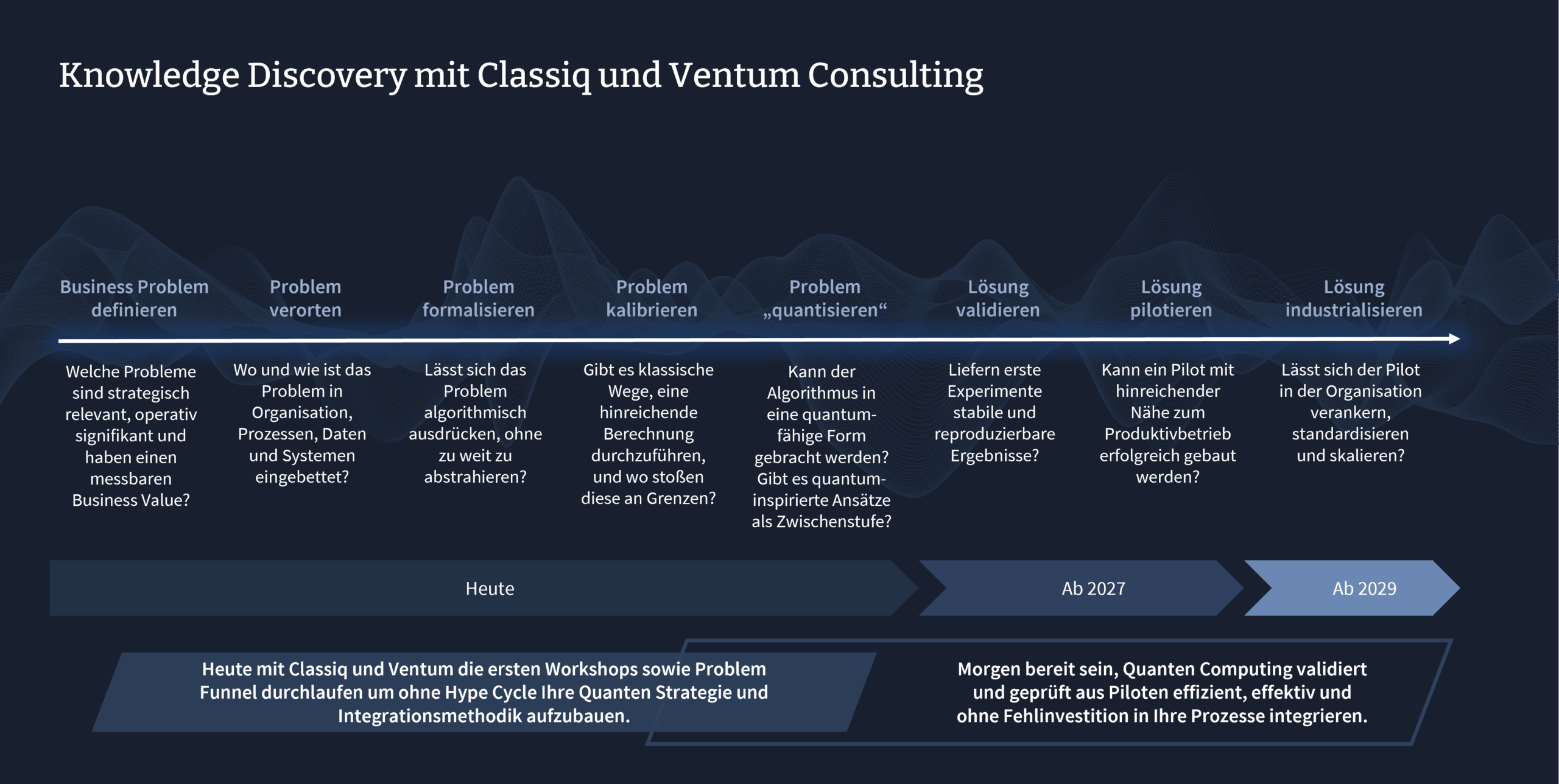
The “no-regret moves” make it clear: The first business value of quantum readiness doesn’t arise only from a quantum-based pilot project with a potential performance advantage. It arises earlier, through better decisions. Companies gain clarity on which problems are relevant, where today’s solutions reach their limits, and which investments actually make sense. This is precisely the step we aim to systematize together with Classiq through our Quantum Knowledge Discovery: identifying the right problems, evaluating them thoroughly, and deriving an evidence-based path to quantum readiness.
Our offering in partnership with Classiq: Quantum Knowledge Discovery – From strategic questions to well-founded decisions
The most costly mistakes in transformation programs result from acting too late or making investments without a solid foundation. Our Quantum Knowledge Discovery provides you with both: the right timing and the right foundation.
By the end of the Knowledge Discovery process, you will know which of your business problems are truly suited for new computational methods, where traditional or AI-based approaches remain superior today, and what specific steps your organization needs to take to be ready to act when fault-tolerant systems become available.
Why Choose Ventum Consulting for Quantum Readiness
+1,500 projects
completed
Large corporations and small and medium-sized businesses trust our experience because we deliver on our promises. Time and time again.
Over 20 years
Consulting Expertise
We know the pitfalls and the shortcuts so you can get where you’re going faster.
100% Dedicated to Your
Business Success
Our success is measured by the tangible added value we bring to your business.
Strategy through
Implementation
We take full responsibility from planning through to implementation—this ensures efficiency and reliability.
+1,500 projects
completed
Over 20 years
Consulting Expertise
100% Dedicated to Your
Business Success
Strategy through
Implementation
- Talk directly with subject matter experts—no sales team involved
- Free Assessment of Your Situation and Needs
Classiq x Ventum Consulting: In-depth quantum knowledge meets enterprise expertise
Building quantum readiness requires more than just access to technology. Our partner Classiq brings in-depth expertise in quantum software and algorithms and provides a quantum software platform. With this platform, teams can design, optimize, and run quantum applications on supported quantum hardware and simulators. Classiq supports the translation of complex optimization problems into quantum-enabled models. We at Ventum Consulting, on the other hand, bring the business transformation and enterprise integration perspective: identifying business-critical problems, linking them to strategy and operations, and driving adoption through architecture, governance, and delivery.
Together, we guide clients through a seamless journey—from identifying the relevant business problem, through structured experiments and organizational learning, to industrial integration—when the technology and business case warrant it.
Why Choose Ventum Consulting for Quantum Readiness
The impact of AI and quantum computing is not being felt equally across all industries. Some industries are already on the cusp of profound changes because their core business processes rely on sophisticated optimization and simulation. These industries face complex optimization problems with many constraints, high economic leverage per percentage point of improvement, and existing AI or operations research setups that serve as benchmarks.
Manufacturing
- Core problem: Complex production and logistics planning with strict constraints such as machinery, setup times, materials, and delivery dates.
- AI Today: Reinforcement learning heuristics are effective in operational settings but are limited by local optima.
- Quantum Tomorrow: Improved global production plans through structure-based encoding, hybrid models combining QC baseline and AI for real-time control.
Finance and Insurance
- Core issue: Risk modeling and portfolio optimization subject to regulatory constraints.
- AI Today: Scenario generation and heuristic evaluation models, but high computational costs and low interpretability.
- Quantum Tomorrow: Explicit restriction encoding facilitates auditability and yields better solutions for highly constrained portfolios.
Energy, Utilities, and Logistics
- Core issue: Optimization of dynamic networks, such as energy routing, power grid distribution, or fleet planning.
- AI Today: Solid operational performance, but limited when dealing with extremely large, heavily constrained network instances.
- Quantum Tomorrow: Initial demonstrations point to the potential for improved optimization in routing and power distribution.
Conclusion: Quantum readiness is a decision that makes future benefits possible in the first place
Quantum readiness is not a bet on technology. It is a management decision about the right time to learn. Experience with generative AI has shown that technological maturity comes faster than organizational readiness. Those who started too late back then had to catch up under pressure. With quantum computing, every organization still has the choice today to do things differently.
This doesn’t mean relying on uncertain hardware promises. It means laying the groundwork now that will make a difference later: identifying business-critical problems, establishing robust baselines, conducting structured experiments, and translating insights into architecture, governance, and skills. Companies that embark on this path today will bridge the gap between future technological possibilities and real business impact. Companies that wait will have to catch up on the same work later under pressure and will miss out on growth opportunities.
“Enterprises can begin building the knowledge and software they will need to take advantage of advances in quantum computing,” says Nir Minerbi, CEO and co-founder of Classiq
Quantum Readiness:
Schedule a no-obligation initial consultation now
Classiq and Ventum Consulting combine quantum expertise with business and integration expertise to bridge the gap between new technological possibilities and measurable business value.
- Looking Ahead: Gain Strategic Clarity for Your Quantum Roadmap
- Demand-oriented: Solutions that exactly match your goals, data structures and decision-making processes
- Extensive Experience: Over 20 Years of Expertise in Digital Transformation and New Technologies
- Low Risk: Gain insights early , avoid bad investments, and make confident decisions
- Effective: From Analysis to Measurable Value Addition in Your Core Processes

TISAX and ISO certification apply only to the Munich location
Your message
Take a look at our news










FAQ – Frequently Asked Questions About Quantum Readiness
Quantum readiness refers to a company’s ability to use quantum computing cost-effectively and at scale as soon as the technology is ready. This includes an understanding of relevant business problems, robust baselines, suitable data sets, governance, skills, and partner structures. All of this takes time. Those who wait until hardware is scalable to get started will lose valuable months.
Not yet widely available. Today’s systems are still prone to errors and limited in the number of qubits they can handle. Fault-tolerant systems aren’t expected until around 2029/30. That is precisely why we need to start organizational preparations now: If we wait until the hardware is ready, we’ll start the learning curve too late.
AI is data-driven. It identifies patterns in historical data and is now widely available and ready for productive use. Quantum computers operate on a structure-based approach. They encode optimization problems directly into quantum states and offer potential advantages in situations where data is limited, classical methods provide only approximations, or regulatory requirements mandate traceability. Both technologies are complementary, not competitive.
Quantum computing offers potential advantages for highly complex simulation and optimization problems with many hard constraints, where global optima can have a significant economic impact. Typical problem classes include complex production and logistics planning, portfolio optimization subject to regulatory requirements, energy grid control, and risk modeling.
“Time to Knowledge” describes how long it takes a company to gain reliable insights into whether and how a problem is suitable for quantum algorithms. This process typically takes six to twelve months. Companies that wait until the hardware scales up to get started will lose this head start to competitors who have already established benchmarks and baselines.
Yes. Data products, governance structures, experimental frameworks, cloud and HPC capabilities, and operations research expertise gained from ongoing AI transformations provide a real competitive edge. They do not automatically make an organization quantum-ready, but they can significantly shorten the distance to the starting line.
Five “no-regret” moves can be made without significant upfront investment: First, identifying economically relevant optimization problems. Second, documenting existing baselines from traditional optimization, AI, and HPC. Third, formalizing selected problems with clear learning objectives and stopping criteria. Fourth, feeding insights back into architecture, governance, skills, and partner strategy. Fifth, translating early quantum readiness into initial strategic guidelines and establishing a stable use-case funnel.
Classiq brings deep expertise in quantum software and algorithms, including a quantum algorithm platform with AI integration. Ventum Consulting brings the business transformation and enterprise integration perspective: identifying economically relevant problems, linking them to strategy and operations, and steering adoption through architecture, governance, and delivery. Together, both partners support an end-to-end journey from the relevant business problem to industrial integration.
We start with a no-obligation initial consultation, during which we work together to identify which of your business challenges might be relevant to quantum computing and where existing investments in AI and analytics can give you a competitive edge. This isn’t a large-scale transformation program, but rather a structured, evidence-based introduction with clear learning objectives.