





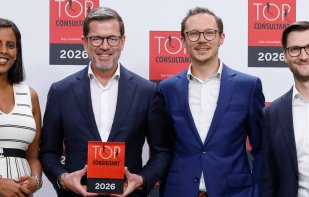
- Veröffentlichung:
23.07.2026 - Lesezeit: 13 Minuten
IT/OT Consulting – Strategically Integrating IT and Production
In most companies, IT and production feel like separate worlds: different systems, different processes, different languages. While IT manages data and information flows, Operational Technology (OT) controls machines, equipment, and physical processes. However, with advancing digitalization, the growing use of artificial intelligence (AI) in production, increasing security requirements, and the rising demand for real-time manufacturing data, this separation is becoming a strategic risk—to efficiency, security, and competitiveness.
At Ventum Consulting, we combine the worlds of IT and OT into a single, integrated system. Our IT/OT consulting services guide you from strategic assessment through architecture and integration to organizational convergence and security. The result: seamless data flows, clear lines of responsibility, and a digital infrastructure that not only connects your production processes but also makes them controllable and future-proof.
Executive Summary – IT/OT at a Glance
- Strategic Importance: The convergence of IT and OT is not an option, but a prerequisite for sustainable digital transformation in manufacturing companies—with a direct impact on efficiency, security, and competitiveness.
- Operational Benefits: Seamless data flows from the shop floor to management, higher service quality, standardized processes, and a better basis for decision-making—achieved by integrating previously separate systems and organizations.
- Security & Compliance: End-to-end cybersecurity strategies spanning both IT and OT, demonstrable compliance with NIS2 and IEC 62443, and a security architecture that protects both worlds rather than getting stuck in between them.
- Organizational convergence: Clear governance, shared processes, and an integrated role model ensure that IT and OT do not operate in silos but function as a single team—with shared goals and joint responsibility.
- AI Readiness: Harmonized data architectures and clean interfaces lay the groundwork for AI applications in production—from predictive maintenance and quality optimization to advanced automation and assistance systems.
IT/OT – Why Is Convergence So Crucial?
IT and OT are often two separate areas with their own structures, budgets, and priorities. Production facilities continuously generate data that is often of limited use to IT. This results in data silos, a lack of transparency, and unclear responsibilities. At the same time, digitalization and the increasing use of AI in OT organizations are leading to an ever-growing IT component in day-to-day work. The consequences of this separation are tangible, and the reasons for resolving it now are more urgent than ever:
- Data silos hinder transparency and AI readiness: Without integration, production data remains trapped in isolated systems—end-to-end transparency from the shop floor to management is impossible, and AI initiatives fail due to fragmented, inconsistent data foundations.
- Industry 4.0 and AI require seamless data flows: IoT, IIoT, and cyber-physical systems generate enormous amounts of data at the field level. Machine learning, predictive maintenance, and AI-driven quality optimization require that this data be harmonized, contextualized, and transferred to IT systems.
- Real-time data becomes the basis for decision-making: Customers, business units, and management expect real-time production data—for control and data-driven decisions. This is only possible if IT and OT work together seamlessly.
- Security risks increase with greater connectivity: The lack of end-to-end security processes spanning both IT and OT creates attack vectors that, in the worst-case scenario, can lead to the failure of business-critical infrastructure. NIS2, IEC 62443, and industry-specific requirements mandate end-to-end security concepts—with a duty to provide evidence.
- Legacy systems are holding back digital transformation: Evolving OT landscapes with proprietary protocols and isolated data sets prevent integration. Without a clear modernization strategy, digital initiatives remain piecemeal.
- Organizational silos prevent synergies: Separate teams, budgets, and processes lead to duplication of effort, inefficiencies, and inconsistent standards. Modernization projects fail because IT and manufacturing are not planned together.
Our IT/OT Consulting Services: From Separate Worlds to an Integrated End-to-End System
IT/OT consulting is not a one-off project. It is a strategic transformation that encompasses architecture, processes, organization, and security in equal measure. Our consulting services cover all aspects critical to successful convergence: from assessing your current state to data architecture and integration, all the way to organizational embedding and security. At Ventum Consulting, IT/OT convergence is not a technology project, but rather a business transformation—integrated with your digitalization strategy, your production realities, and your company’s regulatory requirements.
IT/OT Strategy & Vision
IT/OT Assessment & Maturity Analysis
Shared Vision & Target Operating Model
Value Analysis & Use Case Prioritization
IT/OT Roadmap & Investment Planning
Data Architecture & Integration
Industrial Data Architecture
Interface Integration & Protocol Harmonization
Legacy Modernization & Brownfield Transformation
Cloud Connectivity & Edge Computing
Organizational Convergence & Governance
IT/OT Governance & Decision-Making Structures
Change Management & Cultural Development
Capacity and Competency Planning
Cyber Security & Compliance
Comprehensive IT/OT Security Strategy
NIS2 Readiness & Regulatory Compliance
Security Operations Across IT and OT
Data Usage, Analytics, and AI Readiness
Real-Time Dashboards & Production Transparency
Data Harmonization & Semantic Layer
AI Readiness & Preparation for Advanced Analytics
OEE Optimization & Data-Driven Efficiency Improvements
Our IT/OT Consulting Experts



Why Choose Ventum Consulting for IT/OT Consulting?
: Over 1,500 Projects Completed
Large corporations and small and medium-sized businesses rely on our experience because we deliver what we promise—time and time again.
Over 20 Years of Consulting Expertise at
We know the pitfalls and the shortcuts—so you can get where you’re going faster.
100% Dedicated to Your
Business Success
We aren’t satisfied until you are, because it’s the measurable results that count. That’s how we measure our success.
Strategy through
Implementation
Everything from a single source—so there are no gaps between concept and impact that cost time and money.
+1,500 projects completed
Over 20 Years of Consulting Expertise
100% Dedicated to Your Business Success
Strategy through
Implementation
- Talk directly with subject matter experts—no sales team involved
- Free Assessment of Your Situation and Needs
IT/OT Consulting with Measurable Results—At Every Stage of Your Transformation
Phase 1 – Determine the Location & Assess the Maturity Level
A thorough assessment of your IT and OT landscape: systems, networks, data flows, processes, and organizational structures. Evaluation of maturity levels and identification of data silos, technical debt, and opportunities for integration. Result: A clear picture of the current situation and prioritized areas for action.
Phase 2 – Develop the Target Vision, Architecture, and Security Concept
Development of a shared vision for IT and OT, including a target operating model, data architecture, and an end-to-end security concept. Definition of governance structures and the role model. Result: An integrated vision with a clear roadmap that combines organizational, technical, and security-related requirements.
Phase 3 – Integrate, Implement, and Secure
Implementation of prioritized measures: interface integration, protocol harmonization, legacy system modernization, development of the target architecture, and implementation of network segmentation. Result: Seamless data flows, elimination of silos, a scalable technical foundation, and a robust security infrastructure.
Phase 4 – Embed the Organization & Empower Teams
Establishing shared governance, embedding standardized processes, and implementing active change management. Training and empowering IT and OT teams for the new, integrated collaboration. Result: IT and OT work as one team—with clear responsibilities, uniform standards, and true convergence.
Phase 5 – Optimize, Scale, and Further Develop
Continuous improvement of integration, development of new use cases, enhancement of AI readiness, and scaling to additional locations and facilities. Result: A comprehensive IT/OT system that grows with your company and delivers lasting value.
Support – Change Management & Empowerment
Communication, mutual understanding, and training throughout all phases—to ensure that technical convergence is also supported at the organizational and cultural levels.
Arrange a non-binding initial consultation now
- Future-Oriented: Integrating IT and OT into a Single, Comprehensive System—for Efficiency, Transparency, and Competitiveness
- Tailor-made: Custom solutions precisely tailored to your system environment, processes, and organization
- Proven: Over 20 years of expertise from successful digitization and integration projects
- Strong Implementation Capabilities: IT/OT Consulting—from Strategy and Current State Assessment to Integrated Operations
- Value-driven: A clear focus on sustainable benefits, end-to-end security, and genuine organizational convergence
TISAX and ISO certification apply only to the Munich location
Your message
Take a look at our news









FAQ - Frequently Asked Questions About IT/OT Consulting
IT (Information Technology) encompasses software, hardware, and communication technologies for data processing and information flows. OT (Operational Technology) encompasses the control and monitoring systems that companies use to manage physical devices, equipment, and production processes. In most companies, these are two separate areas—each with its own structures, priorities, and teams.
The convergence of IT and OT leads to higher service quality, greater cost efficiency, and improved availability of production systems. The benefits include more efficient service and incident management, a higher degree of standardization, and end-to-end security strategies.
An assessment of the current situation and strategy development typically takes four to eight weeks. Full organizational and technical convergence is an ongoing process that—depending on the complexity and number of locations—is implemented in phased steps over a period of months to years.
No. Existing legacy systems can be gradually modernized using encapsulation technologies and integrated into modern architectures—without compromising the core control system and without posing any production risks.
Through a shared vision, integrated governance structures, standardized processes, and active change management. We support both cultural transformation and technical integration—so that IT and OT are not just connected, but become a true team.
The cost depends on the scope and complexity of your transformation. From a concise readiness assessment to comprehensive convergence support, we’ll create a transparent, modular proposal—so you get exactly the support your company needs.